
Out of sight, out of mind: design a space your brain can't forget
If you can't see it, your brain files it under gone. That's not object permanence — it's working memory. Here's how to build a space that keeps what matters in view.
The Paffie Team
June 13, 2026
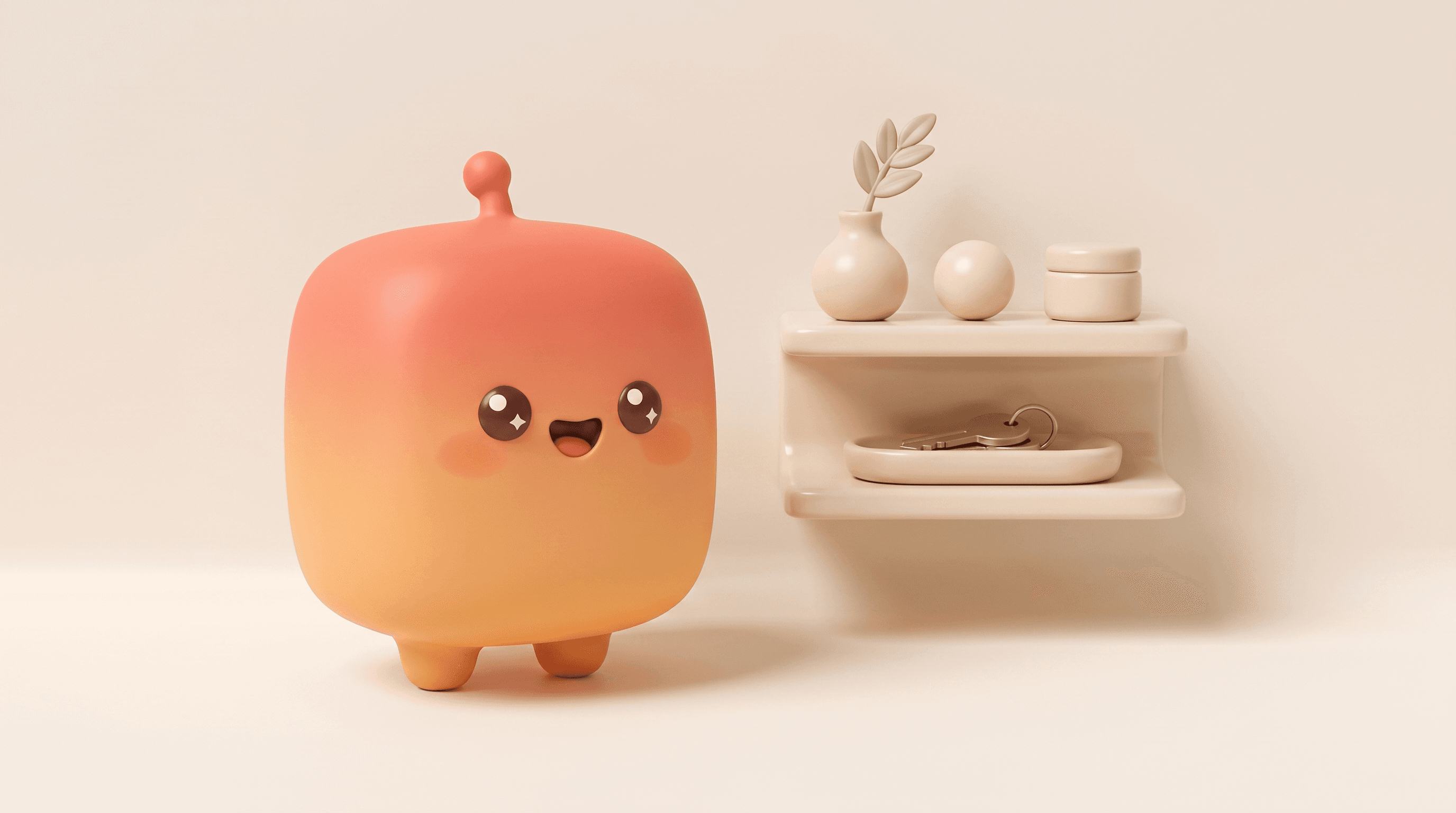
There's a pile on the chair. You know the one. It started as a single sweater and quietly became a small civilization — half-clean laundry, a tote bag, four days of mail, the charger you swore you lost and rebought. Meanwhile the vitamins you meant to take every single morning are sitting exactly where you left them, in the cupboard behind the door, invisible and untouched since spring.
If a thing isn't in your line of sight, your brain files it under gone. The bill you can't see isn't unpaid — it doesn't exist. The friend you meant to text back doesn't nag at you at all, until their name floats up out of nowhere two weeks later with a fresh wave of guilt. The ADHD community calls this losing "object permanence." That's not quite the right name for it — but the feeling is dead accurate.
It's not object permanence — it's working memory
Let's clear this up kindly, because the label matters. Object permanence is the baby-and-peekaboo thing: knowing a toy still exists when a blanket covers it. You have that. You know your keys exist somewhere on this planet. What actually happens is closer to a working-memory and attention gap — as one plain-language summary puts it, people with ADHD know things exist when they can't see them, they just have no idea where those things are, or the thought of them drops out of mind entirely the moment they're out of view.
So "out of sight, out of mind" isn't a metaphor for you. It's a fairly literal description of how the machinery works. Which means the fix isn't remember harder. You can't willpower your way into holding twelve invisible things in mind at once — nobody can. The fix is to stop asking your memory to do a job your environment can do for free.
This is a systems problem, not a character problem. And systems, unlike willpower, hold still while you build them.
The one principle
Here it is, the whole thing on a sticky note: to remember something, put it where your eyes already go. To forget it, get it out of sight.
Your visual field is the most reliable reminder you own. It's on all day, it never runs out of battery, and it doesn't ping you into a shame spiral. So the work splits into two jobs: turn down the noise, and turn up the signal.
Job one: subtract the noise
A cluttered desk isn't just ugly — it's a pile of tiny distractions, each one a small tug on your attention. That out-of-place mug, the random cable, the receipt from Tuesday: every stray object is a little open loop whispering deal with me. Twenty of them and your focus is being pickpocketed all day by things you're not even looking at directly.
This is why a clear surface is a genuine feature, not an aesthetic preference. Same goes for your digital space — a desktop buried in icons and forty open tabs is the exact same clutter, just glowing. Clearing it isn't tidying for tidying's sake. It's removing decoys so the real signal can get through.
Job two: add the signal
Once the noise is down, you deliberately put the few things that matter back into view: your current task, your next task, your active project, your keys. Not everything — that just rebuilds the pile. Just the handful of things you cannot afford to have vanish.
The goal is a space with almost nothing on it — except the two or three things you'd be sunk without. Empty surface, loud signal. That contrast is what makes the signal actually land.
Concrete moves for a bad-brain day
None of these require motivation to maintain. That's the point — you build the system once, on a good day, and it carries you on the bad ones.
- 1Build a launch pad by the door
One tray or hook for keys, wallet, and bag — nothing else. Everything that leaves the house with you lives here. This one move quietly cancels a big chunk of the ADHD tax: the lost, re-bought, frantically-searched-for essentials.
- 2Clear one surface completely
Not the whole room. One surface — your desk, or the counter by the kettle. Clear it to bare, and let that be your signal zone for whatever matters right now.
- 3Swap drawers for open, clear containers
A drawer is a tiny box of forgetting. If it matters, keep it in an open basket or a see-through jar. Visible storage beats tidy-but-hidden every time.
- 4Keep your task list physically in view
Pin it to a third of your screen, or write today's three things on a card propped where you'll stare at it. A list you have to open is a list you'll forget to open.
- 5Put tomorrow's cue where you'll trip on it
Gym bag in front of the door. Pills next to the coffee. Meds you only take when they're on the counter? Then the counter is where they live. Let future-you literally bump into the reminder.
Here's a quick scan you can run on any room or screen — anything that fails, fix:
- The thing I need to do next is visible right now, without opening anything
- My keys, wallet, and bag have one home, and it's by the door
- My main work surface is clear except for what I'm doing today
- The essentials I forget (meds, water, chargers) sit out in the open, not in drawers
- My screen shows my task list, not forty tabs hiding it
- Tomorrow's first cue is already placed where I'll physically encounter it
Go gentle here. The aim isn't a magazine-perfect minimalist home — that's a different kind of pressure you don't need. You only have to clear enough space for your real signals to stand out. Ruthless about the noise, generous with yourself.
Where Paffie fits
Your physical space handles keys and pills. But a lot of what vanishes on you isn't an object — it's a task, floating in your head one second and gone the next. That's the same problem, indoors. Paffie gives it the same fix: brain-dump the swirl of to-dos out of your mind so they stop tugging at you, then keeps today's focus surfaced — visibly, in your line of sight — so the thing that matters can't quietly slip back into the "not now, therefore never" fog. Out of your head, into view, where your brain can actually find it.
Paffie is free to start.
Match your energy, capture the noise, and do the next right thing — in about a minute a day.
This is a systems idea with a little brain science attached, not medical advice. ADHD care — including whether medication is right for you — is a conversation for you and a qualified professional.

Bring this into your day
Paffie turns ideas like these into a gentle daily rhythm that works with your energy.